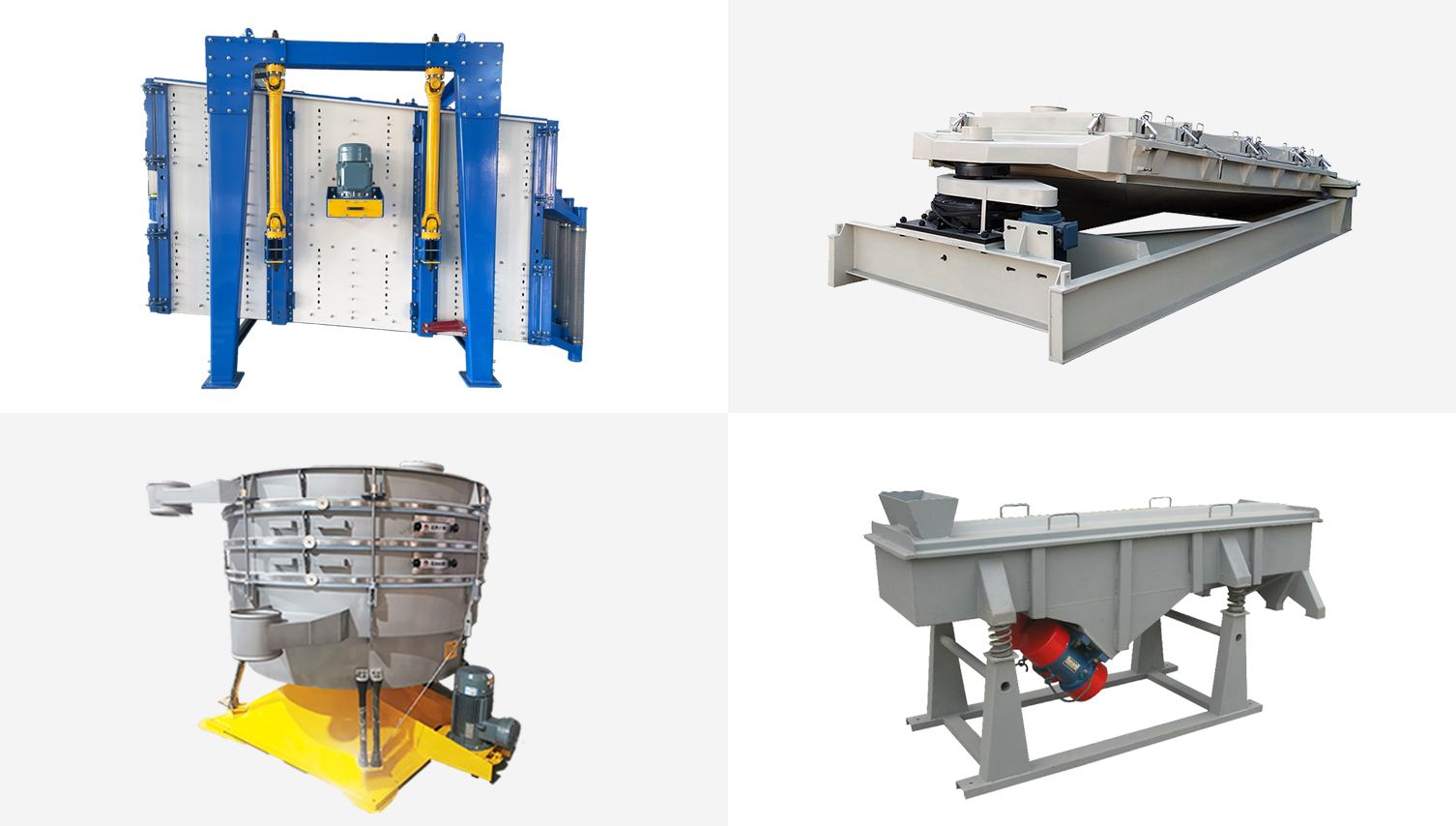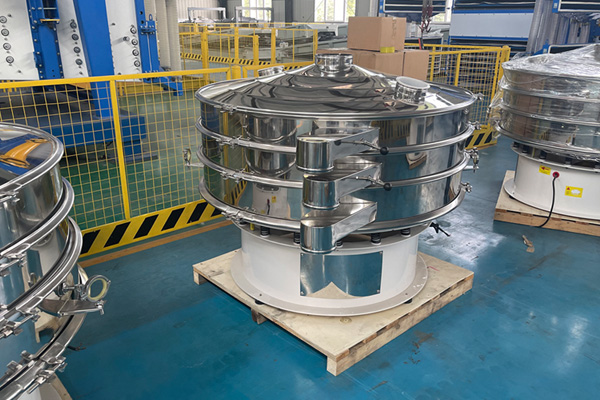
In an automated screening production line system, the vibrating rotary screen, as a high-precision and highly versatile core screening device, is a key device for achieving material grading, impurity removal, and purification. Unlike the single vibration mode of traditional linear screening equipment, the vibrating rotary screen relies on a unique three-dimensional vibration principle to achieve efficient and precise material screening, adapting to the continuous and standardized operation requirements of the production line. It is one of the core pieces of equipment for improving the quality and efficiency of modern screening production lines.
The entire operating system of the vibrating rotary screen uses a vertical vibrating motor as its core power source, which is also its core structural difference from ordinary screening equipment. During operation, the eccentric weights installed at both ends of the vertical vibrating motor rotate synchronously, generating a continuous and stable excitation force through the centrifugal force of the rotating eccentric weights. Under the action of the excitation force, the entire machine body, including the screen base, screen frame, and screen mesh, will not shake in a single direction. Instead, it forms a three-dimensional rotary vibration trajectory combining vertical, horizontal, and inclined forces. The entire vibration is uniform and controllable, without local jamming or amplitude deviation, laying the foundation for stable screening.
From the perspective of the complete screening process, after the material is evenly fed onto the screen surface through the feed inlet at the top of the equipment, it will undergo multiple motion states driven by the three-dimensional vibration. On the one hand, the material is affected by the vertical vibration, constantly jumping up and down, which effectively breaks up material agglomeration and adhesion, preventing fine materials from clumping together and failing to pass through the screen, thus reducing screening blockage at its source. On the other hand, the horizontal rotational vibration force will push the material to perform a circumferential diffusion motion along the radius of the screen mesh, allowing the material to quickly and evenly cover the entire screen surface, preventing material accumulation and local overload. At the same time, the inclined force will guide the material to slowly move towards the discharge outlet, forming a continuous and uninterrupted closed-loop process of feeding, screening, and discharging, perfectly adapting to the continuous operation mode of the production line.
In terms of core screening logic, the vibrating screen relies on the standardized specifications of the screen mesh aperture to achieve precise material classification. Fine materials with a particle size smaller than the screen mesh aperture smoothly penetrate the screen under the action of high-frequency vibration and fall into the bottom discharge channel for discharge; coarse materials and impurities with a particle size larger than the screen aperture are intercepted on the screen surface, continue to move with the vibration trajectory, and are eventually discharged from the top discharge port. Through the use of multiple screens, a single vibrating screen can simultaneously complete the classification of 2-6 different particle sizes of materials, greatly simplifying the equipment layout of the screening production line.
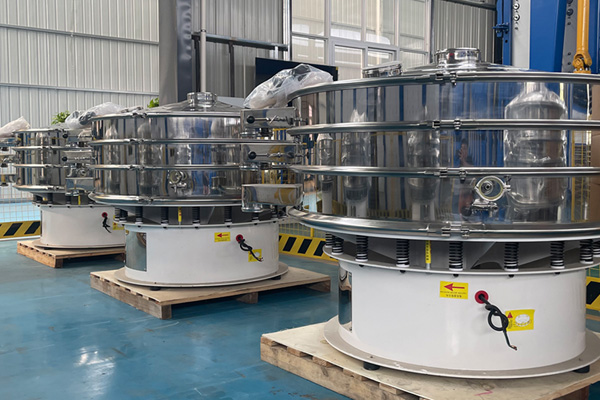
It is worth noting that the vibration frequency, amplitude, and material trajectory of the rotary vibrating screen can all be precisely controlled by adjusting the angle between the upper and lower eccentric weights and the counterweight. Operators can flexibly adjust the equipment's operating parameters according to the material's moisture content, particle size, and specific gravity, adapting the equipment to the screening needs of different materials. This is the core reason why the rotary vibrating screen has become a universal core piece of equipment in screening production lines. The entire operating principle has no complex mechanical transmission structure; it uses a pure vibration screening mode, resulting in lower energy consumption and more stable operation, providing a reliable guarantee for long-term continuous operation of the production line.
Clearly separated particles, intelligent screening –Mirant Xinxiang Machinery Co., Ltd.